





TABLE OF CONTENTS:
SASE vs SSE - Quick Answer
-
SASE (Secure Access Service Edge) combines SSE with SD‑WAN into a unified architecture
-
SSE (Security Service Edge) delivers cloud‑based security services such as ZTNA, SWG, CASB, and FWaaS
In short:
-
SASE = Networking + Security
-
SSE = Security Layer
The real question most enterprises get wrong
Most enterprises evaluating these architectures ask:
“Is SASE better than SSE?”
That’s not the question that leads to the right decision. The real question is:
What is actually limiting your environment today, security, connectivity, or both?
-
If your WAN is stable but security hasn’t kept pace, you have a security problem
-
If performance, routing, and visibility are also fragmented, you have a combined architecture problem
At Orixcom, this distinction shows up in almost every enterprise conversation. Very few organisations need everything at once, but most need clarity on where the real gap sits.
What is the difference between SASE and SSE?
Gartner introduced SASE in 2019 as a converged architecture combining wide-area networking with cloud-delivered security. Three years later, they created SSE as a distinct category for the security component of SASE, designed to work independently of the WAN layer.
What is SASE (Secure Access Service Edge)?
SASE is an architecture that combines networking (SD-WAN) and cloud-delivered security (SSE) into a unified framework to manage connectivity and access across distributed environments.
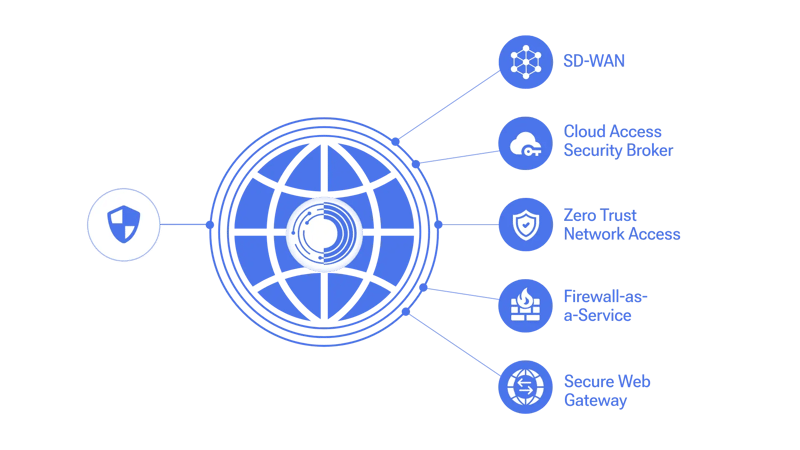
What is SSE (Security Service Edge)?
SSE is the security component of SASE, delivering services such as ZTNA, SWG, CASB, and FWaaS to protect users, applications, and data, independent of the underlying network.
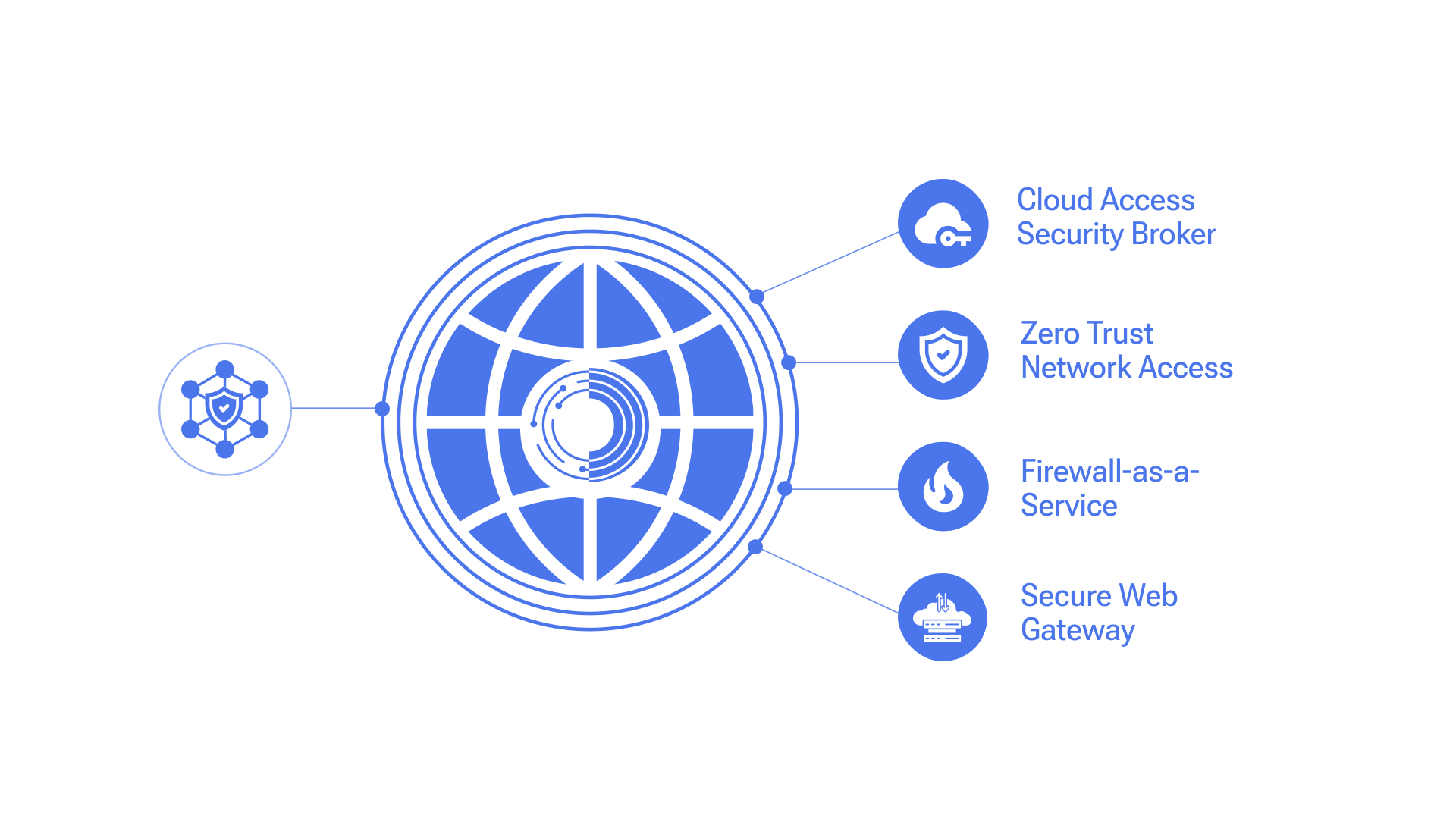
So basically, SASE brings together:
- Networking (SD-WAN)
- Cloud-delivered security (SSE)
SSE focuses only on security services delivered from the cloud.
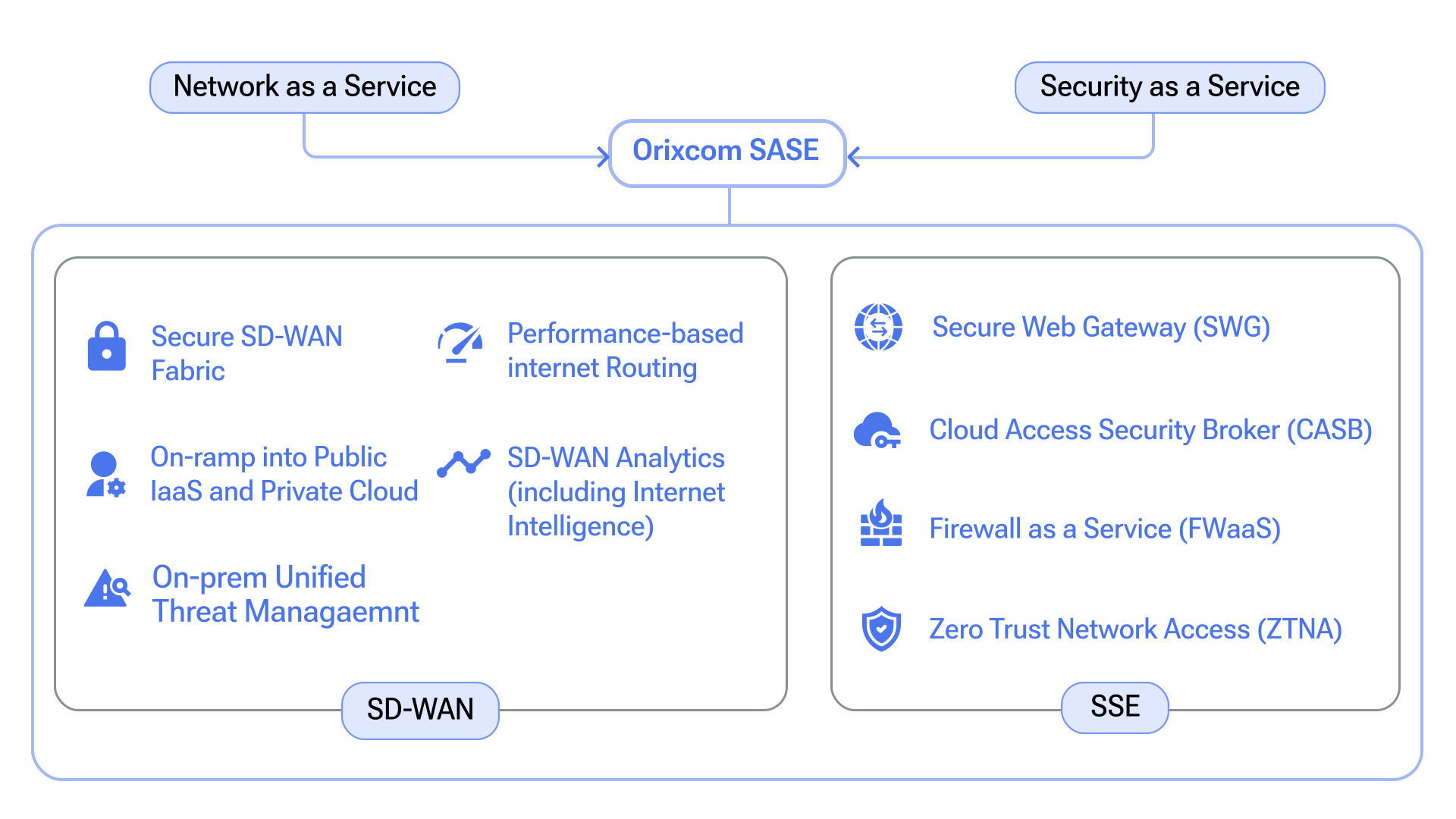
The relationship is one equation: SD-WAN + SSE = SASE
SSE is the security half. SD-WAN is the connectivity half. Together they form complete SASE.
Key clarifications:
-
Is SSE part of SASE?
Yes. SSE is the security layer inside SASE.
-
Does SASE always include SD-WAN?
Yes. Without SD-WAN, it’s not SASE, it’s SSE.
What each framework is built from
SASE is built on two layers:
- Connectivity (SD-WAN – Software-Defined Wide Area Network)
- Security (SSE – Security Service Edge)
Together, they define how traffic moves and how that traffic is secured.
The difference between SASE and SSE comes down to this:
- SSE secures access
- SASE secures access and controls how traffic gets there
Security Layer: SSE Components
SSE delivers the cloud-based security foundation used in both SSE-only deployments and full SASE architectures.
| Component | What It Does | What It Addresses |
| ZTNA (Zero Trust Network Access) | Provides application-level access based on user identity, device posture, and context. Replaces broad VPN network access with controlled access to specific applications. | Remote access risk, VPN replacement, distributed workforce access control. |
| SWG (Secure Web Gateway) | Inspects internet-bound traffic at the cloud enforcement point closest to the user. Applies URL filtering, DNS security, SSL inspection, anti-malware, and sandboxing consistently. | Internet traffic exposure and inconsistent inspection for remote users. |
| CASB (Cloud Access Security Broker) | Monitors cloud application access, enforces data handling policies, identifies anomalous behaviour, and provides visibility into shadow IT. | SaaS visibility gaps, shadow IT, data loss risk, and compliance requirements in cloud environments. |
| FWaaS (Firewall as a Service) | Delivers next-generation firewall capabilities from the cloud with centralised policy enforcement. | Traffic bypassing hardware firewalls, remote users, and branch cloud breakout. |
What SD-WAN adds in a complete SASE architecture
While SSE secures access, SD-WAN controls how traffic moves across the wide area network. It makes routing decisions based on real-time network conditions and application requirements rather than static configuration. Within a SASE model, SD-WAN acts as the “connect it” layer, complementing the “protect it” security layer (SSE). It introduces:
-
Performance-based routing
Traffic is directed based on real-time conditions such as latency, loss, and application priority—not fixed paths
-
Secure, intelligent connectivity fabric
Branches, users, and cloud environments are connected through a consistent SD-WAN layer
-
Direct on-ramp to cloud and IaaS platforms
Users and applications connect directly to cloud environments without unnecessary backhaul
-
Integrated analytics and visibility
Network performance and user experience are continuously monitored and optimised
What this means in practice:
-
Real-time applications (voice, video, SaaS) get priority paths
-
Background traffic uses available capacity without impacting performance
-
Users experience consistent performance regardless of location
Why this changes the architecture
Without SD-WAN:
-
Security is enforced through SSE
-
But traffic still follows legacy routing models, disconnected from security policy
With SD-WAN:
-
Connectivity becomes policy-driven and application-aware
-
Networking and security decisions operate within the same architectural framework
This is where SASE becomes more than a combination of parts.
Architectures built on a unified platform, such as Cisco’s SASE framework, bring together:
-
Performance-based routing
-
Cloud-delivered security
-
Shared visibility and policy control

SASE vs SSE: The comparison that helps you decide
At a high level, both SASE and SSE deliver the same security capabilities. The difference is whether connectivity is part of the architecture or remains separate.
| Dimension | SSE | Complete SASE |
| Architecture Scope |
Security layer only |
Networking (SD-WAN) + Security (SSE) |
| SD-WAN |
Not included. Existing WAN operates independently. |
Integrated with security policy management. |
| WAN Routing and Performance |
Dependent on existing network |
Application-aware, performance-based routing |
| Application Access Control (ZTNA) |
Core capability. |
Same capability within a unified architecture. |
| Internet Traffic Inspection (SWG) |
Core capability. |
Same capability. |
| SaaS Visibility and DLP (CASB) |
Core capability. |
Same capability. |
| Cloud Firewall (FWaaS) |
Core capability. |
Same capability. |
| Policy Framework |
Unified across security components only. |
Unified networking and security policy framework. |
| Replaces VPN |
Replaces traditional VPN with ZTNA for application-level, identity-driven access |
Replaces VPN and aligns access with both security and application-aware routing |
| Hybrid Workforce Security |
Fully addressed. |
Fully addressed with WAN optimisation. |
| Tool Consolidation |
Consolidates security tools. |
Consolidates both networking and security tools. |
What this comparison means for your architecture
The capabilities are not the differentiator. The architecture is. Both SSE and SASE deliver the same core security stack, ZTNA, SWG, CASB, and FWaaS.
What changes is:
Whether connectivity remains separate, or becomes part of that same framework.
When is SSE the right choice?
When your connectivity is working and the security layer is the gap.
Many enterprises have invested significantly in WAN infrastructure that is performing well. Branches are connected, routing is functioning, the network team has no active complaints. What those environments are often missing is consistent security enforcement across remote users, proper visibility into SaaS application usage, and application-level access control to replace VPN. Those are security layer problems, not connectivity problems.
SSE addresses them directly. It operates independently of whatever WAN is in place, which means the security gaps close without any change to the connectivity infrastructure that is already working. There is no dependency on WAN contracts, no need to coordinate a simultaneous connectivity programme, and no risk of disrupting branch operations that are currently stable.
For cloud-first organisations with no complex multi-site WAN, the same logic applies. If users primarily access SaaS and cloud services over direct internet connections, the security layer is what needs attention. SSE covers that completely. SD-WAN in that environment adds operational complexity without addressing the actual requirement.
When does complete SASE make sense?
When the connectivity layer is part of the problem, not just the security layer.
Some enterprises find that both sides of the equation need work at the same time. The security posture is fragmented, but so is how traffic moves between branches, cloud environments, and users. When application performance varies significantly across sites, when networking and security teams are operating entirely separate toolsets with no shared visibility, or when a WAN modernisation programme is already in motion commercially, addressing both together through complete SASE is more efficient than running two separate initiatives at different times.
The operational case is particularly relevant when the networking and security teams have historically worked in silos. Separate tools, separate dashboards, separate escalation paths when something goes wrong. When an incident occurs at the intersection of connectivity and security, determining where the problem actually sits takes longer than it should. Complete SASE brings both disciplines under a single policy framework. Getting there requires both teams to genuinely align before deployment begins, which is harder than the technology change itself, but the operational result justifies the effort.
Can you start with SSE and move to SASE later?
Yes, and many organisations take exactly this path.
The security components in an SSE deployment (ZTNA, SWG, CASB, FWaaS) become the enforcement layer of complete SASE when SD-WAN is introduced later. When you stay within the same vendor platform, the policy framework, identity integrations, and access rules carry forward. Nothing needs to be rebuilt from scratch. The investment is preserved and extended, not replaced.
This matters practically for organisations where the WAN conversation is not commercially ready yet. Get the security layer right now. Bring SD-WAN into the architecture when the timing allows. The two phases are compatible by design. Many organisations begin with SSE and later transition to a full SASE strategy as networking and security requirements evolve. Get the complete picture with our SASE adoption guide.
What to Evaluate First: Security Controls, PoP Coverage, or Latency?
Security controls first. PoP coverage second. Latency third.
Strong PoP coverage and low latency figures mean nothing if the platform cannot enforce the policies your environment requires. Capability comes first. Once that is confirmed, evaluate whether the provider's enforcement infrastructure is actually close to where your users are. Latency is primarily determined by PoP proximity; evaluating it without first checking coverage gives you numbers that lack context.
For compliance-sensitive environments, add two further checks before finalising any provider: where does the provider process and store traffic logs (relevant if your organisation has data residency obligations), and how complete is the IAM integration (partial integration produces incomplete audit trails, regardless of how sound the rest of the architecture is).
Extra Read: Learn how SD-WAN with ZTNA extends SASE to enforce Zero Trust security across distributed networks and users.
Will SSE Actually Reduce Tool Sprawl?
Yes, but only if the migration is handled properly.
Replacing separate VPN infrastructure, web proxy, CASB, and hardware firewalls with a unified SSE platform removes the policy inconsistency that comes from managing those tools independently. Different tools applying different rules to the same user in different contexts creates gaps that tend not to surface until an incident reveals them. A unified platform closes those gaps structurally.
What vendors rarely say upfront: if your existing tools carry years of accumulated customisation, policy mapping is required before anything gets decommissioned. Organisations that treat SSE adoption as a straightforward swap and skip the migration work tend to find the gaps during incidents rather than during testing. Those that map existing configurations into the SSE platform first, validate them, and retire tools in phases have a significantly smoother experience.
Which Architecture Fits Your Situation?
| Your Environment | What It Indicates | Recommended Approach |
| WAN performing well but security gaps exist |
Connectivity is stable, but access control, SaaS visibility, or policy consistency is lacking |
SSE to standardise security without impacting existing infrastructure |
| Existing WAN contracts still active |
Security improvements are needed before the WAN refresh cycle |
SSE now → SASE later by layering security first and aligning connectivity over time |
| Cloud-first and SaaS-heavy environment |
Minimal reliance on branch-to-branch traffic; most access is direct to cloud applications |
SSE to secure user access and data without introducing unnecessary network complexity |
| Both networking and security need modernisation |
Performance issues, visibility gaps, and fragmented tooling exist across both layers |
Complete SASE to unify routing, access, and security under one architecture |
| Building infrastructure from scratch or redesigning architecture |
An opportunity exists to unify networking and security from day one. |
Complete SASE |
| Networking and security teams are highly fragmented |
Separate tools, inconsistent policies, and slow troubleshooting across domains |
Complete SASE to align visibility, policy, and operations across both teams |
How Orixcom approaches this decision
At Orixcom, the decision between SSE (Security Service Edge) and SASE (Secure Access Service Edge) is never treated as a product choice. It is an architecture decision, one that depends entirely on how your environment operates today and what outcomes you need to achieve.
Every engagement starts with a structured assessment across three areas:
-
Connectivity — how your WAN is designed, where bottlenecks or inefficiencies exist
-
Security — where enforcement gaps appear across users, applications, and access points
-
Access and Identity — how users connect, what IAM integrations are in place, and where visibility is limited
This gives a clear view of:
-
Whether the issue is security-only (SSE)
-
Or whether both connectivity and security need to evolve together (SASE)
Built on a unified Cisco SASE framework
Orixcom delivers both SSE and SASE using Cisco’s SASE architecture, bringing together performance-based routing (SD-WAN), cloud-delivered security (ZTNA, SWG, CASB, FWaaS), and a unified policy and visibility model across both layers. In practice, this means security policies are applied consistently across users, applications, and locations, while network behaviour and security events are visible through a single operational view. Connectivity and security decisions are no longer managed in isolation, but operate as part of the same framework. The result is not just layered technology, it is a cohesive architecture that performs predictably at scale.
Frequently Asked Questions (FAQs)
Q1. What is the difference between SASE and SSE?
SSE focuses only on cloud-delivered security services such as ZTNA, SWG, CASB, and FWaaS. SASE combines those security capabilities with SD-WAN under one architecture.Q2. When is SSE enough for an enterprise?
SSE is usually enough when the existing WAN is performing well and the main requirement is improving security, remote access, SaaS visibility, or policy consistency.Q3. When should an enterprise choose full SASE instead of SSE?
Complete SASE makes more sense when both networking and security need modernisation at the same time, especially across distributed branch environments.Q4. How do compliance and data protection requirements influence SSE vs SASE choice?
Enterprises should evaluate where traffic logs are processed, how data is stored, and whether IAM integrations provide complete audit visibility.Q5. What security services are typically included in SSE?
SSE commonly includes ZTNA, SWG, CASB, FWaaS, and often Data Loss Prevention (DLP).
Q6. Will SSE reduce tool sprawl compared to point products?
Yes. SSE can consolidate VPNs, web proxies, CASB tools, and distributed firewall platforms into a unified security framework.